Category: Uncategorized

  • Stitching the Spirits: Gaelic Fairies, Samhain, and Our October Half-Term Costume Workshop

    Stitching the Spirits: Gaelic Fairies, Samhain, and Our October Half-Term Costume Workshop

    On Thursday 16th October, 1pm – 3pm and Thursday 23rd October, 1pm – 3pm we’ll be running some family workshops here at Làmhan. As the nights have been drawing in and the smell of woodsmoke drifts through the air when we are outside, I find myself thinking again about Samhain — the old Gaelic festival marking the turn of the year, when the veil between worlds grows thin. Here in Callander, beneath the shadow of Ben Ledi, those ancient rhythms still feel close. The hill has long been associated with both Beltane and Samhain, the twin fire festivals of the Celtic year.
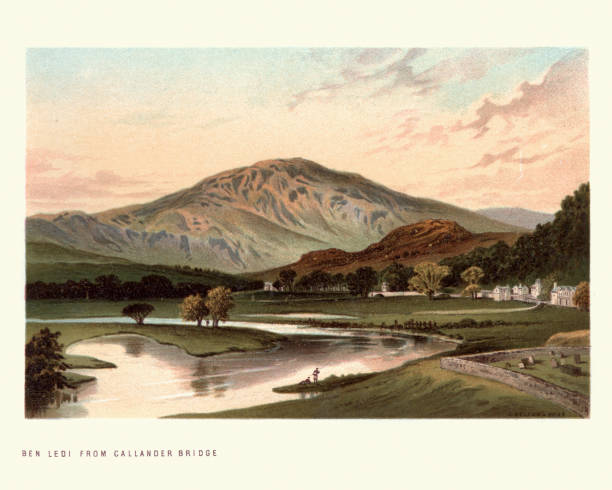
    Vintage engraving of Ben Ledi from Callander Bridge, Perthshire, Scotland 19th Century. Ben Ledi (Beinn Leitir in Scottish Gaelic) It is 879 m (2884 ft) high, and is classified as a Corbett.

    I’ve often thought that this association — Ben Ledi as a site of pre-Christian fire rituals — is why Reverend James Robertson, Callander’s minister in the late eighteenth century, tried to Christianise its name. He reinterpreted Beinn Leathaid as Beinn Le Dia, “Hill of God.” It was a neat act of rebranding, but it reveals something deeper: that the older spiritual life of the landscape still shimmered beneath the surface. That same spirit of renewal and creativity is what we’re celebrating with Làmhan’s Samhain Costume Workshop this October — two afternoons of storytelling, laughter, and making, right here in Callander.
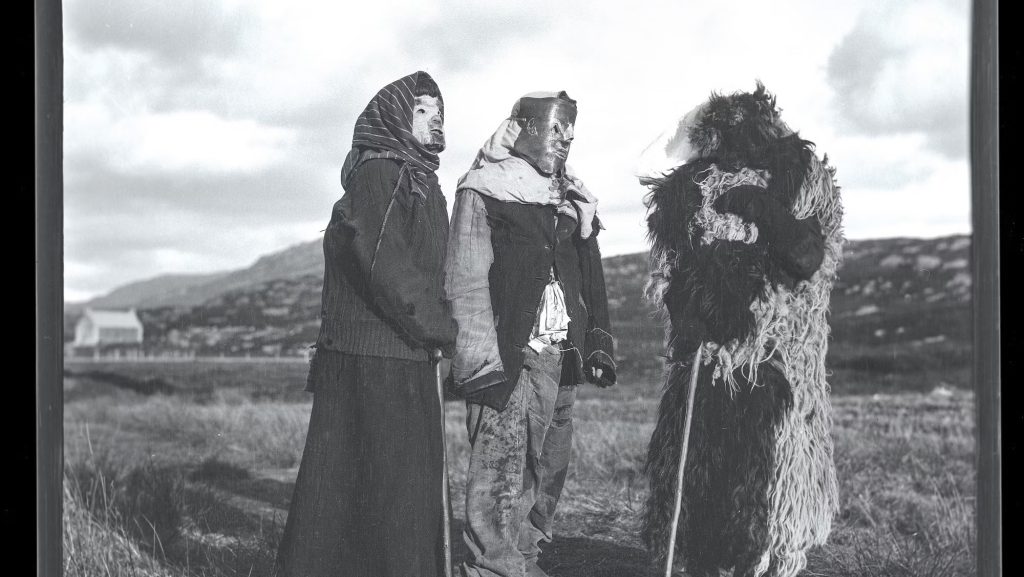
    In Gaelic tradition, Samhain wasn’t simply the end of harvest; it was the time when the sìthichean — the fair folk — could move freely between their world and ours. People lit fires, shared food, and disguised themselves not to frighten, but to belong. One of my favourite glimpses of these old disguises comes from Margaret Fay Shaw’s photographs in South Uist, taken in 1932. Her images show island children wrapped in rags, seaweed, and old coats — resourceful, funny, and full of life. That’s the spirit we’ll be reviving: creativity, community, and a little well-placed mischief.
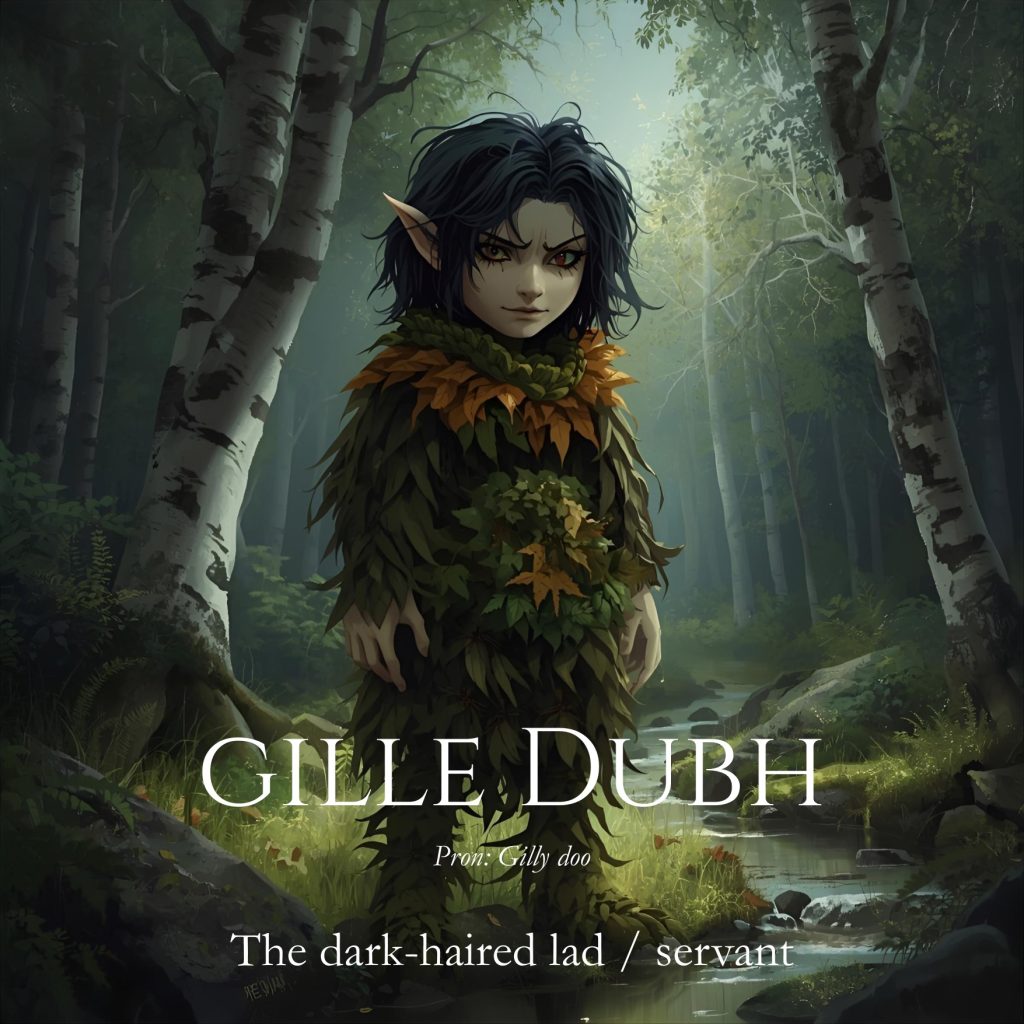
    We’ve shaped the workshop around a family of Highland spirits so everyone has a role to play. The Ban-Sìth (Banshee) as the mother, calm and luminous, draped in soft off-white fabric. The Brownie (Brùnaidh) as the father, the steady hearth spirit in worn wool and a hint of tartan. The Ghillie Dubh as the sons, shy forest keepers in green and mossy tones. The Sìthiche, the mischievous daughters, full of energy and colour. And the Each-Uisge as the family pet, inspired by the kelpie of Loch Venachar. Local lore tells of that creature and of the northern woodland once known as Coille na Bròin — the Wood of Sorrow — where laughter and warning walked side by side.
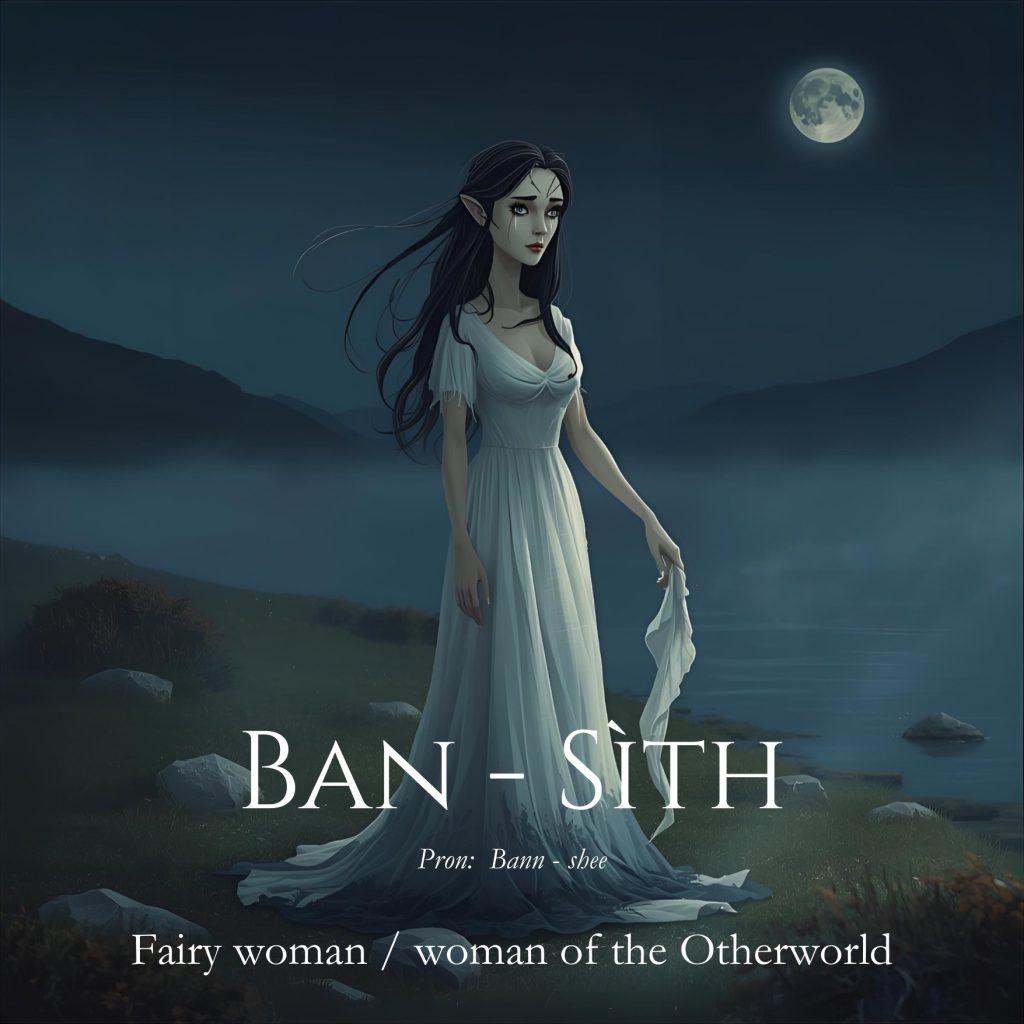
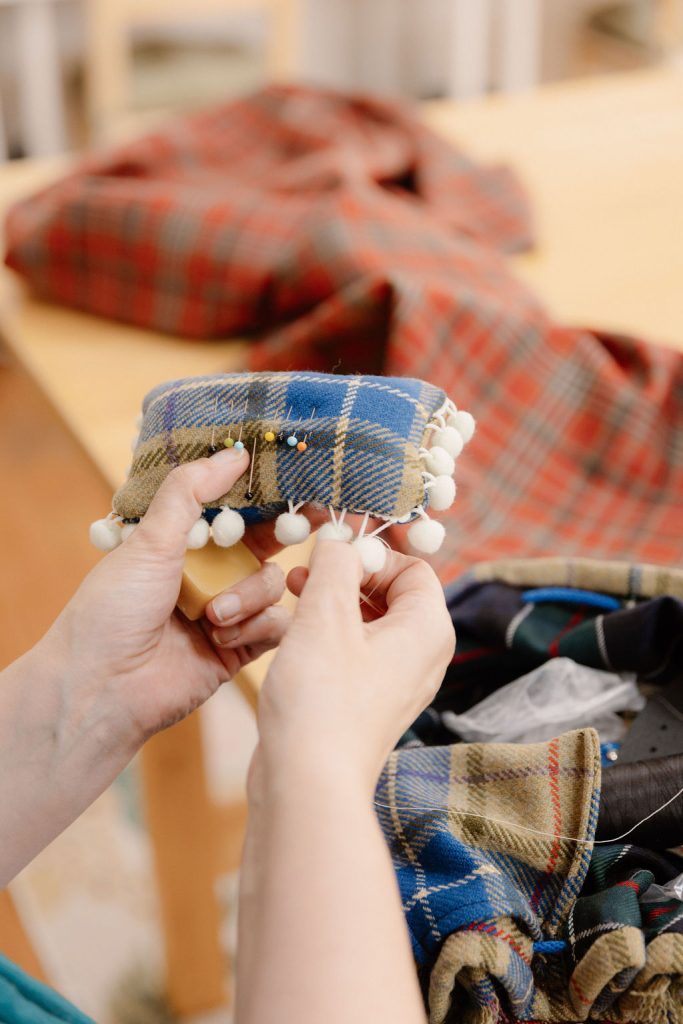
    We’ll begin with a few stories about Samhain and the sìthichean, then spend the afternoon making our costumes together. We’ll provide pre-cut felt and fabric pieces ready to stitch or glue, along with basic sewing supplies — thread, scissors, needles, elastic and glue — and of course, juice and biscuits for everyone. Please bring along some old clothes or fabric scraps from home: shirts, scarves, jumpers, pillowcases, anything that can be reimagined into something magical. Each family will leave with at least one finished costume and, hopefully, a few new stories to share.
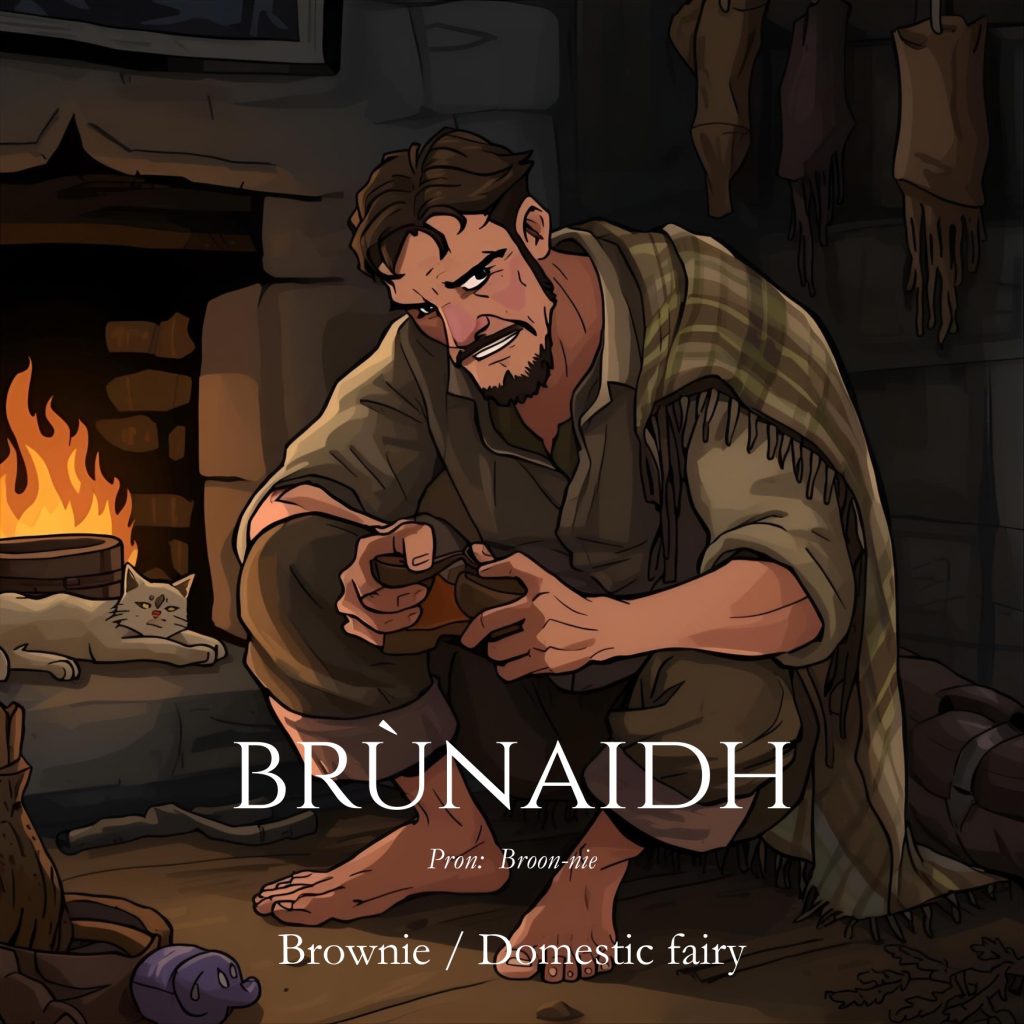
    This isn’t about perfect stitches; it’s about shared making — cutting, pinning, laughing, and creating something together. If your fairy wings or moss capes turn out a little uneven, all the better. The sìthichean were never known for symmetry.
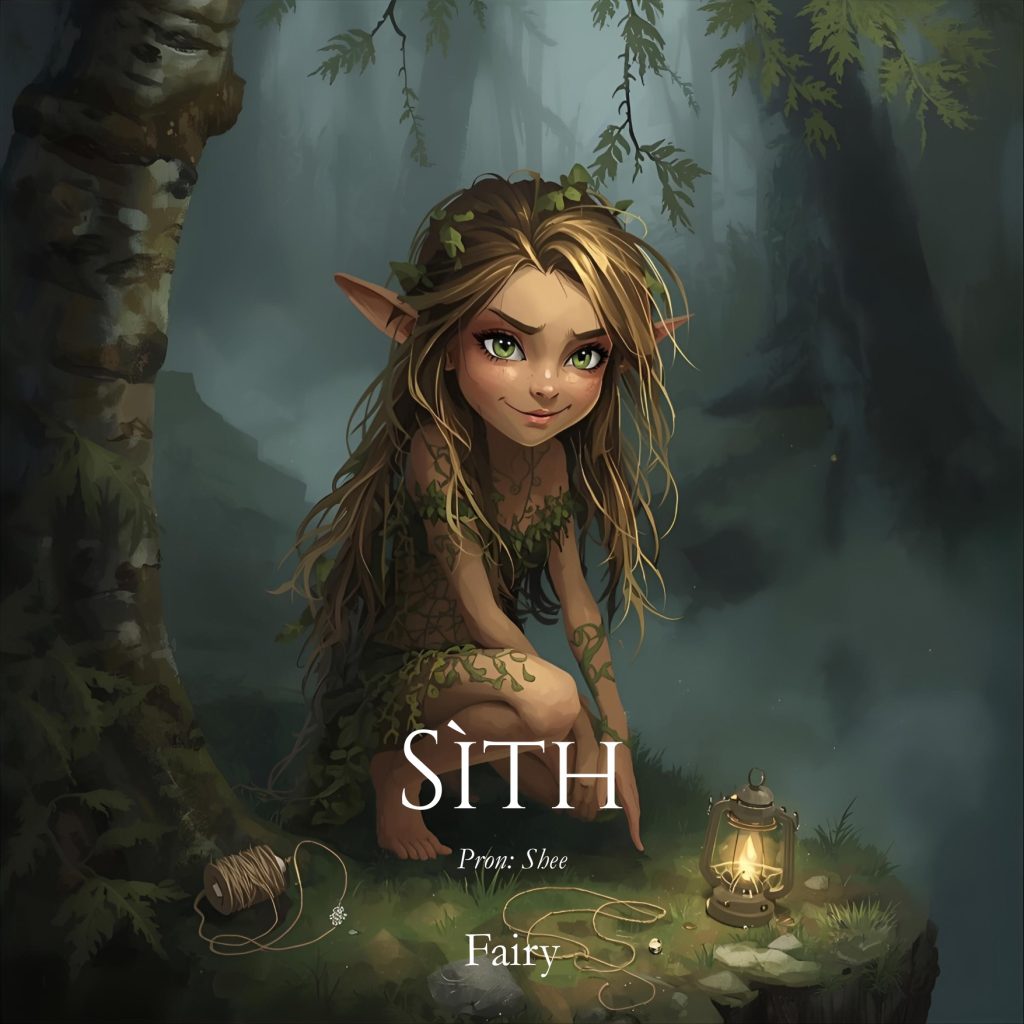
    The Làmhan Samhain Costume Workshop takes place during October half term at our studio in Callander, beneath the gaze of Ben Ledi. We’ll provide the stories, materials, guidance, felt, and refreshments — you bring your family, your imagination, and a bundle of old clothes ready for a new story.

    Together, we’ll celebrate local Gaelic culture, the turning season, and the small everyday magic of making something by hand — just as our ancestors did when the fires of Samhain burned bright on the hills above Loch Venachar and its Wood of Sorrow (the wood at Loch Venachar is called Coille na Bhròin – the Gaelic for Wood of Sorrow).
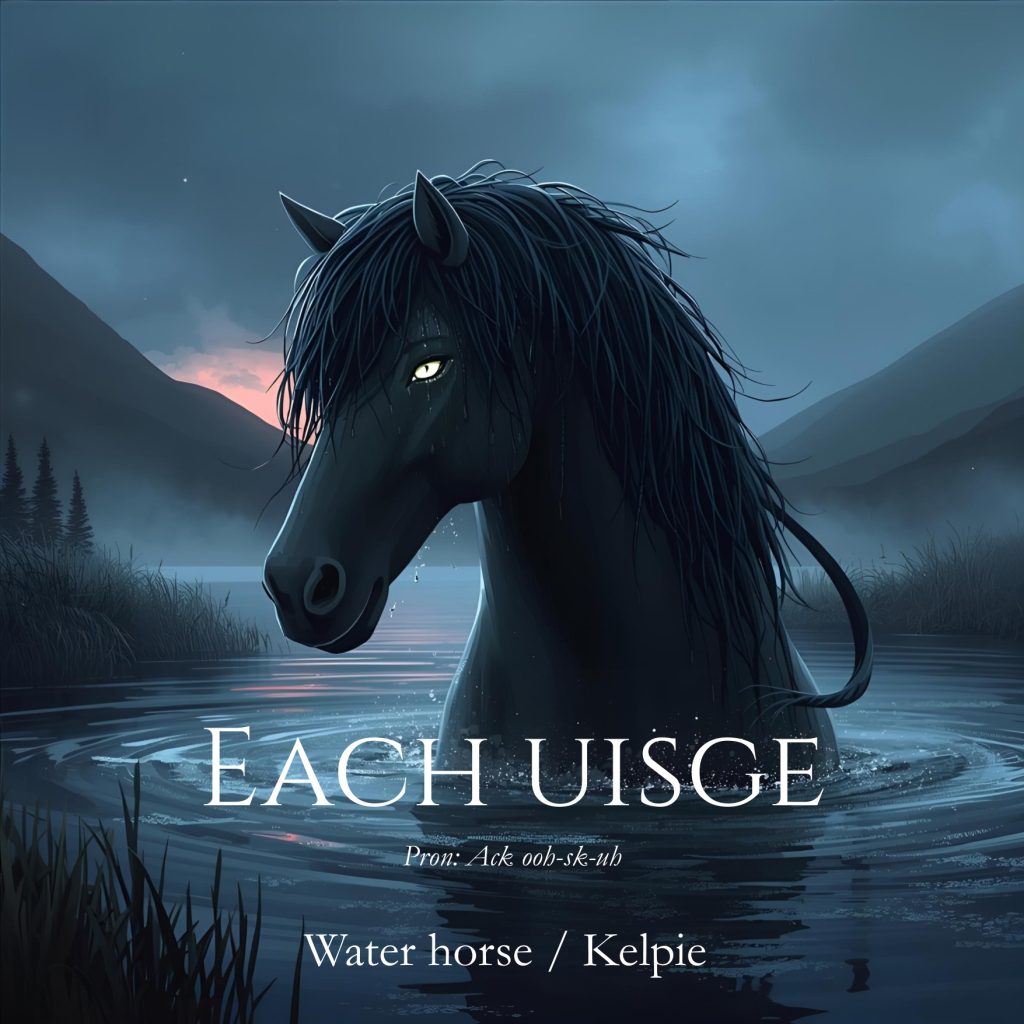
    finally, did you know that Loch Venachar had a kelpie? Come along to one of our two costume making sessions to find out more!

    Price: £25 for one adult and one child, plus £5 for each additional child. All materials (But please bring along some more old fabrics we can use and share), wool felt, sewing needles, threads and of course tea, juice, and biscuits are included. Places are limited to keep things relaxed and hands-on. Booking is open now via our Events Page.

    Edited to add: I created these Cartoonlike images in Canva using the AI image creator function.
  • Why we are going to be teaching Gaelic at Làmhan

    Why we are going to be teaching Gaelic at Làmhan

    I am delighted to share something that is close to my heart: we will soon be offering beginners Gaelic classes — one for adults and another specially designed for parents and children to learn together. This is an intrinsic part of what we hope will be a deep journey of cultural reconnection, shared learning, and a shared commitment to Scotland’s living heritage.

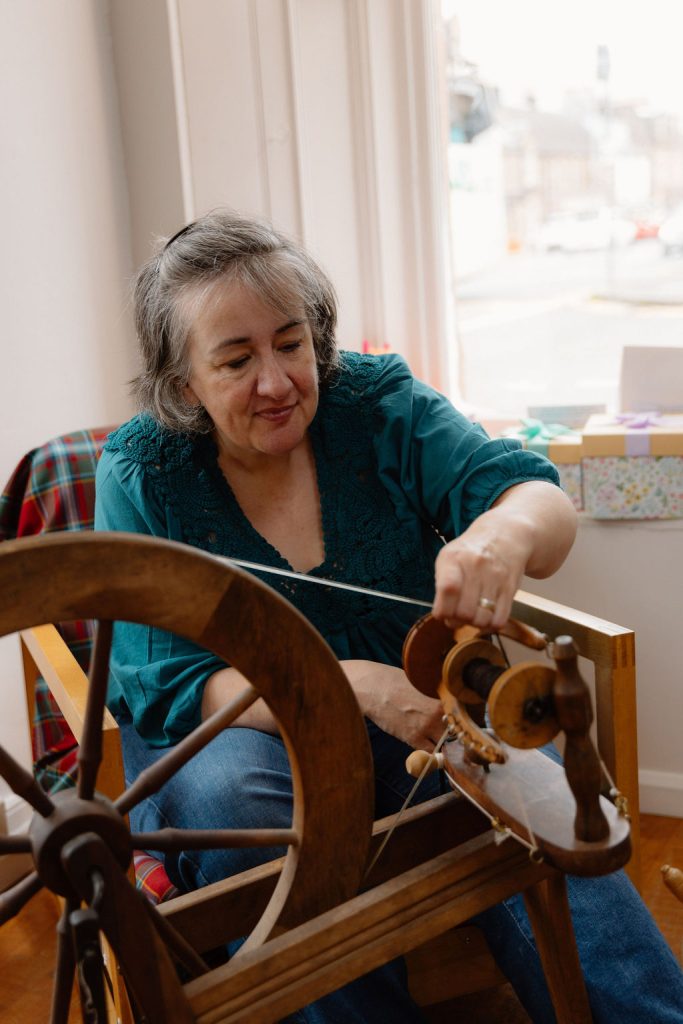
    Me spinning yarn. Done for centuries in this area. I’ll be offering classes in the Autumn/Winter once we are a bit more organised 🙂

    As a practitioners of heritage textile crafts, we know that it is through language that culture breathes, and in our part of the world, that language was once Gaelic. Just over a hundred years ago, Gaelic was the predominant language spoken in Callander and across much of the Trossachs. In the main streeet, at the kirk, by firesides and on the hills, people spoke the language of their ancestors, passing down not only words, but a worldview rich in poetry, nature, and community. Over the last century, that voice has grown quieter, and with the passing of our last native speaker in the 1990s, many believed it had faded from our area entirely. But Gaelic is not lost. It is not dead. It waits, like seed beneath the soil, ready to grow again when nurtured. We want to be part of that nurturing.

    Mhairi nic Aoidh

    Our beginner and children’s Gaelic classes will be taught by local Gaelic Medium Education primary school teacher, Mhairi nic Aoidh. Mhairi has been sharing her love of Gaelic and Gaelic song with children and young people in the local area for many years, and is passionate about teaching the culture alongside the language. Her first class sold out in less than 24 hours, so she has kindly agreed to teach more classes for us.

    She will be supported by our founder, Jo, a proud lifelong learner who brings a deep personal and academic passion to this work. Jo holds two master’s degrees — one in Contemporary Crafts (Textiles) and the other in Highlands and Islands Culture — and it is the learning from these degrees, alongside her self-directed exploration of Gaelic, landscape, and traditional practice, that forms the heart of what Làmhan offers as a charity. Her teaching experience, formerly in French, and her own ongoing Gaelic journey mean she understands both the challenges and the joys of learning a new language later in life.

    We are going to be adding a post beginners class and possibly an intermediate Gaelic class later in the year.

    Our classes will draw on the excellent free resources from LearnGaelic.scot, offering learners access to a wide range of audio, video, and written materials to support and enrich their time with us.

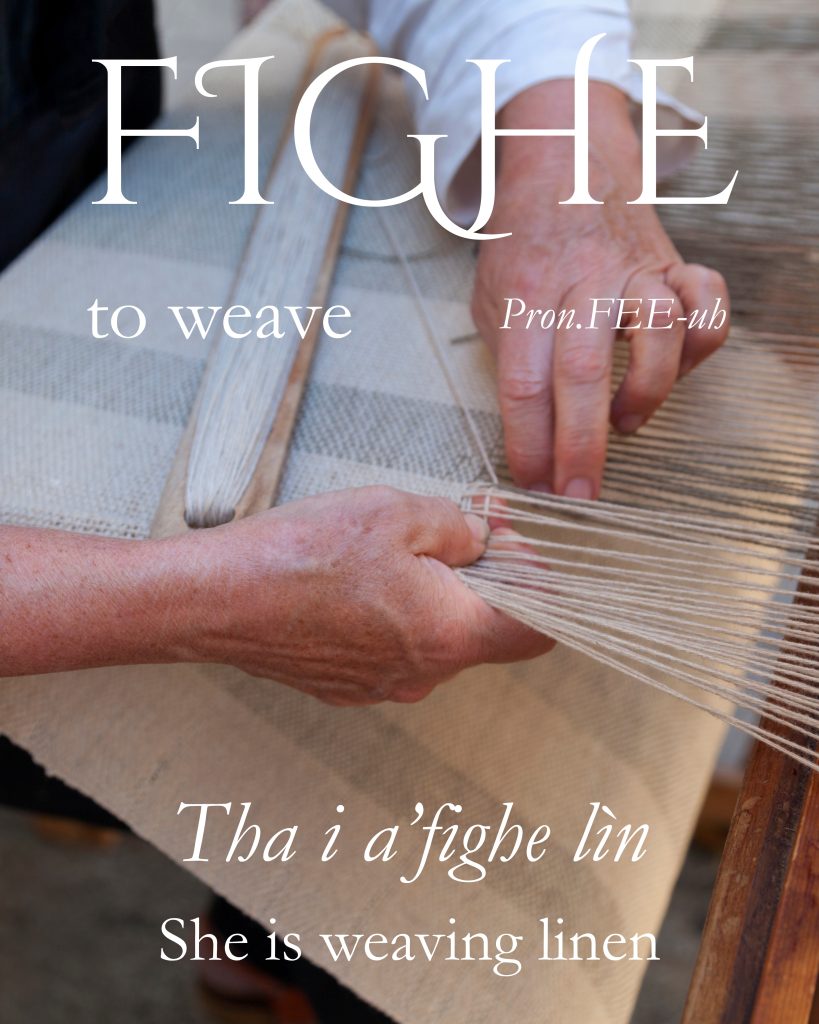
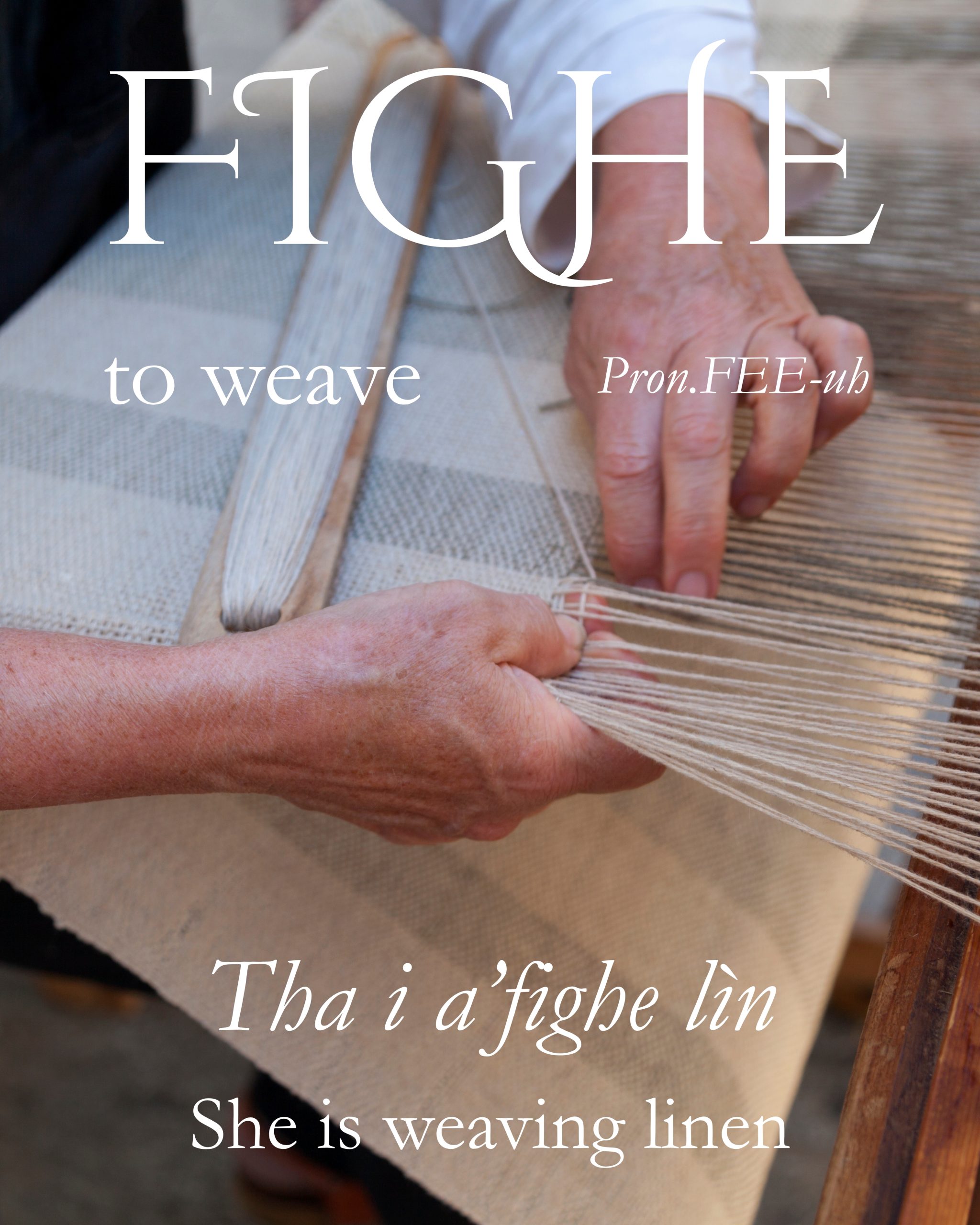
    Every week (on Mondays) I am sharing Gaelic textile-related words and phrases on our Instagram channel. I hope you find them interesting!

    Why combine Gaelic with crafts? Because they are deeply connected. Language carries the knowledge of how to make, how to mend, how to understand the land and the seasons. In learning Gaelic, we connect not just to words but to ways of seeing — and we hope that as people discover or rediscover this beautiful, rich language, they will also feel more deeply connected to the history, creativity, and resilience of those who came before us.

    I believe that in order for our country to understand where it is going, we must first understand where we have been. By reconnecting with the language, the songs, the stories, and skills of those who came before us, we do not just preserve the past — we carry it forward into the future, shaping a Scotland that honours its roots while growing something new.

    Le deagh dhùrachd,

    Jo

  • National Saturday Club

    National Saturday Club

    At Làmhan, we believe in nurturing creativity, building confidence, and opening doors for young people in our community. That’s why we’re thrilled to announce our involvement in the National Saturday Club, a nationwide initiative that offers free, high-quality creative education to 13–16 year olds across the UK.

    What is the National Saturday Club?

    The National Saturday Club is a UK-wide network that gives young people the chance to explore subjects they love — from art and design to fashion, writing, science, and more — in a supportive, inclusive environment. The clubs run on Saturdays during the academic year, giving young people the space to develop new skills, meet like-minded peers, and learn from industry professionals and educators.

    Crucially, the programme is completely free for participants, helping to remove financial barriers and ensure access for all. Each club culminates in a national Summer Show, where the young people’s work is exhibited at Somerset House in London — a moment of real celebration and recognition.

    Why Làmhan Is Taking Part

    At Làmhan, our work is rooted in creativity, culture, and community. We see firsthand the impact that creative expression can have on young people’s confidence, aspirations, and mental well-being. By joining the National Saturday Club, we’re expanding our commitment to youth development and providing a new space for young people in our region to explore their potential.

    This club will give participants the opportunity to experiment with different art forms, explore new materials and techniques, and collaborate on exciting projects — all guided by experienced practitioners from the Làmhan team and beyond.

    Making It Possible: National Lottery Awards for All

    We are proud to share that our Saturday Club is fully funded by the National Lottery Awards for All. Their generous support allows us to offer this programme at no cost to families, helping us reach more young people from diverse backgrounds and ensure that everyone has the chance to take part, regardless of their circumstances.

    We’re incredibly grateful for this funding — it’s helping us make a real difference, empowering the next generation of creatives in our community.

    Get Involved

    Our Saturday Club has already launched! It is open to young people aged 13–16 who are curious, creative, and ready to try something new. We only have a few places left for the 2025/2026 club so we suggest applying sooner rather than later at https://saturday-club.org/club/lamhan/.

    Together, with the support of the National Saturday Club and National Lottery Awards for All, we’re making creative futures more accessible — and we can’t wait to see what our young artisans will achieve.

    Our draft plan for the Club for the year

    Dates: Week 1 – Saturday 6th September, Week 2: 13th September, Week 3: 20th September, Week 4: 27th September, Week 5: 4th October, Week 6: 1st November

    Tutors: Nikkita Morgan (lead) and Gillian Lewis, support from Cara McAllister

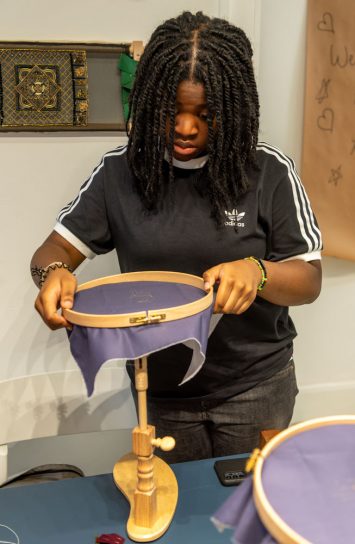
    An introduction to textile techniques with an emphasis on sustainable making. Members will work with deadstock, pre-consumer waste, and recycled textiles to create functional pieces.

    Skills Covered

    • Hand and machine sewing basics
    • Embroidery techniques (e.g., running stitch, backstitch, satin stitch)
    • Intro to patchwork and textile piecing
    • Creative reuse and upcycling principles

    Projects

    • Pencil case
    • Patchwork tote bag
    • Embroidered apron

    Block 2: Ceramics (Weeks 7–10)

    Week 7: 8th November, Week 8: 15th November, Week 9: 22nd November; [National Visit to Edinburgh: Saturday 29th November] Week 10: 6th December

    Tutors: Cara McAllister (lead) and Jo Watson

    Working with air-dry clay and other non-kiln methods to explore the foundations of ceramics in a studio environment.

    Skills Covered

    • Hand-building techniques (pinch, coil, slab)
    • Surface decoration (impressing, carving, painting)
    • Functional design and sculptural forms

    Projects

    • Small decorative or functional ceramic items (e.g., trinket dishes, planters)
    • Collaborative tile piece

    Block 3: Fabric Creation – Weaving, Felting & Dyeing (Weeks 11–15)

    Week 11: 10th January, Week 12: 17th January, Week 13: 24th January, Week 14: 31st January, Week 15: 7th February

    Tutors: Gillian Lewis (lead), Jo Watson, support from Cara McAllister

    Exploration of fibre-based processes to create new textiles from raw or recycled materials.

    Skills Covered

    • Frame and cardboard loom weaving
    • Needle and wet felting techniques
    • Basic spinning (optional)
    • Natural and experimental dyeing methods

    Projects

    • Felted wall piece
    • Small woven textile panel or accessory
    • Dyed and embellished fabric swatches

    Block 4: Knitting (Weeks 16–19)

    Week 16: 14th February, Week 17: 21st February, Week 18: 28th February, Week 19: 7th March

    Tutor: Jo Watson (lead), Gillian Lewis, support from Cara McAllister

    An introduction to the basics of knitting, exploring both form and function in textile construction.

    Skills Covered

    • Casting on and off
    • Knit and purl stitches
    • Shaping and pattern basics
    • Yarn and texture exploration

    Projects

    • Small knitted accessories (e.g., fingerless gloves, phone case, scarf swatches)
    • Group yarn bomb or collaborative piece

    Block 5: Introduction to Kiltmaking (Weeks 20–27)

    Week 20: 14th March, Week 21: 21st March, Week 22: 28th March, Week 23: 25th April, Week 24: 9th May, Week 25: 16th May, Week 26: 23rd May, Week 27: 30th May

    Tutor: TBC and Jo Watson, support from Cara McAllister

    Members will learn traditional handwork and tailoring techniques used in kilt construction.

    Skills Covered

    • Measuring and pleating
    • Stitching techniques specific to kiltmaking
    • Structure and construction methods
    • Pattern matching and fabric handling

    Project

    • A simplified/child’s kilt

    Block 6: Final Project & Exhibition Prep (Weeks 28–30)

    Week 28: 6th June, Week 29: 13th June, Week 30: 20th June

    Tutors: Nikkita Morgan and Gillian Lewis, supported by Jo Watson and Cara McAllister

    Club members will design and create a final project that incorporates techniques and skills learned throughout the year. The project will be displayed in a public showcase or exhibition.

    Focus Areas

    • Independent project planning
    • Combining craft disciplines
    • Presentation and display skills
    • Reflective practice and peer feedback

    Outcome

    • Finished final piece (individual or collaborative)
    • Contribution to end-of-year exhibition

    Additional Notes

    Sustainability is a core theme: recycled, reclaimed, and donated materials will be prioritised throughout. Guest craft professionals may be invited for demos or workshops where possible. The club aims to build not only technical skills, but also creative thinking, teamwork, and personal confidence through making.

  • On dùthchas and dualchas: two key Scottish Gaelic concepts

    On dùthchas and dualchas: two key Scottish Gaelic concepts

    A few years ago, I was lucky enough to study an MLitt in Highlands and Islands Culture at the University of the Highlands and Islands. I took the course over a year and studied modules on a range of fascinating topics, but I think the one which had the most impact on me as a person was The Gaelic Legacy, a module run by Sabhal Mòr Ostaig’s professor Meg Bateman and taught by the wonderful Dr Iain Mac a’Phersain (who I absolutely adore and is quite literally one of the funniest people I’ve ever met).

    The module introduced me to two incredibly important concepts which intrinsically important to anyone studying Highlands and Islands Culture, or working within this field: dùthchas and dualchas. Now here is a confession; I cannot pronounce either word correctly enough for a native speaker to understand which one I’m referring to because my Gaelic is, very sadly, terrible. I’ve tried to learn on several occasions, but I have far too much language interference from my third and fourth languages (I was a polyglot in my younger days) of Greek and German, and Gaelic is such a totally different language to any I have studied before. One might think Greek would be harder to learn, however the difference was that I was in my early to mid twenties when learning Greek (which I did by immersion when living in Greece) and now I’m in my early 50s and my brain struggles to operate at 100% these days. However what I have been able to learn and come to understand is Gaelic culture; I learn through translation and am an avid watcher of programmes on the BBC’s Alba channel. And I have learned that it is in my DNA; someone in my father’s line seemingly did not have the biological father that everyone thinks they did and the biological father was of Irish and Scottish descent. I digress.

    I am busy writing a new business plan at the moment and it is making me think of what I want to include going forward. For me, heritage is vitally important; it is one of the main reasons I have set up this charity (which has not been easy, I can assure you). I am really, really concerned about the state of Scottish heritage crafts. About two decades ago, there were about 100 traditional kilt makers working in Scotland. Nowadays, the Heritage Crafts Association estimates there are about 11-20. While there are people learning how to make kilts, most of those people are hobbyists and learn to make kilts for their friends and family. I am not sure how our most iconic item of dress can survive if something radical isn’t done in the next decade or two, hence this charity hopes to play a small part in doing something positive to help.

    My daughter sewing a kilt for her brother

    Why kilts? Why Highland dress in general? Well, as I’ve already mentioned the kilt is a key element of how others see us. Yet, nowadays, men mainly wear kilts for ceremonial reasons; for weddings, christenings perhaps, graduation and of course to important international football matches.

    I spoke to a kiltmaker a couple of weeks ago, and she told me something which has really stuck in my mind; she wants to bring Highland dress back to the Highlands. This is something I have been thinking about a great deal. How do you go about changing the dress habits of an entire region? Especially when a good proportion of tailored kilts made today in Scotland are not made for Scots, but are actually made for American customers. I think key to this question can be found in dualchas.

    One of the best pieces of business advice I was given last year was to use Chat GPT and Perplexity, both AI tools, to conduct research. It has saved me hours upon hours of research and reflection , and seeing as none of what I am researching is being used in an academic context or for funding applications, I don’t feel bad about using the technology available. I decided that I would ask Chat GPT this afternoon to explain these two concepts and here is what it has come up with. It’s surprisingly accurate, by the way.

    The Scottish Gaelic concepts of dùthchas and dualchas are deeply rooted in Highland culture and tradition, encompassing ideas of heritage, community, and identity. While they are interconnected, each carries its own distinct meaning.

    1. Dùthchas

    Meaning:

    The term Dùthchas refers to an inherent connection to place, land, and ancestry. It embodies the idea of belonging, both to a specific geographic area (such as the Highlands) and to the traditions and people tied to it.

    Core Concepts:

    Inherent Rights: Historically, dùthchas implied the idea of collective land ownership or a community’s right to live and work on the land passed down through generations. It reflects a strong sense of stewardship and responsibility for the land.

    Kinship and Ancestry: Dùthchas often conveys a deep respect for family heritage and the bonds within clans or extended kin groups. It emphasizes the interconnection between people and their homeland.

    Cultural Identity: Dùthchas is an intrinsic part of a person’ss identity, connecting them to their forebears and the values or traditions upheld by their ancestors.

    Examples in Context:

    A Highlander’s sense of dùthchas might be their emotional and spiritual attachment to their family croft or ancestral land. It also evokes the moral obligation to protect and honour the land and its traditions.

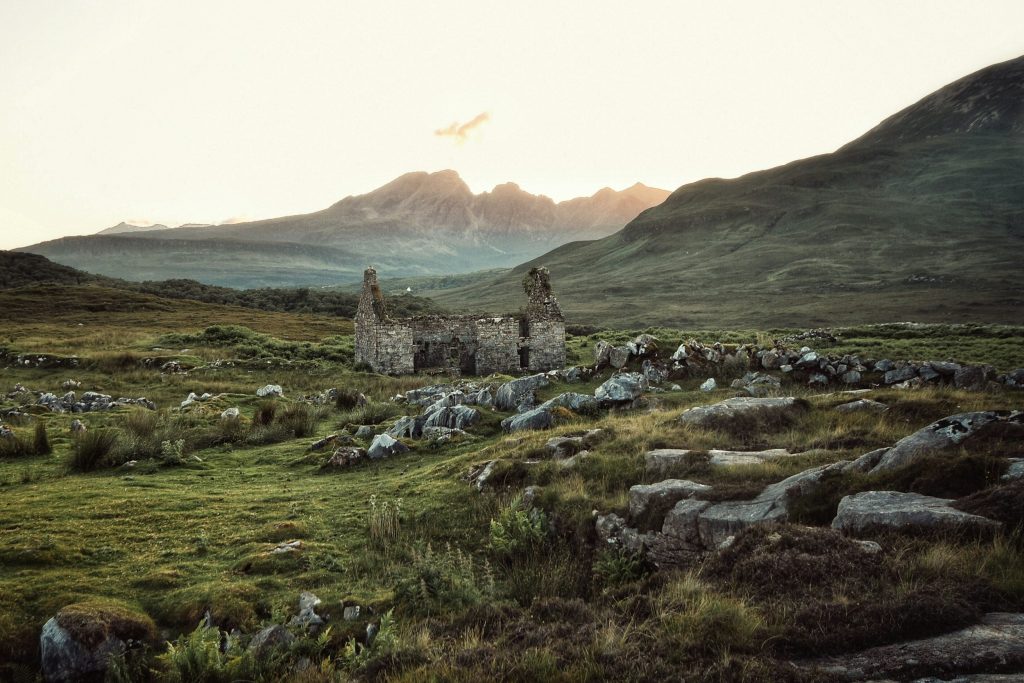
    Great stock image of an abandoned croft from Squarespace

    2. Dualchas

    Meaning:

    The term dualchas relates more to cultural heritage, encompassing the customs, stories, language, and practices that define a community. It is about preserving and passing on traditions to future generations.

    Core Concepts:

    Traditions and Customs: Dualchas encompasses activities such as ceilidhs, storytelling, music, dance, kiltmaking, and Gaelic language preservation.

    Transmission of Knowledge: Unlike Dùthchas, which is more about place and ancestry, dualchas focuses on the living practices that bind communities together over time.

    Shared Values: Dualchas represents a shared cultural identity, including the ethics, beliefs, and traditions that define a group of people.

    Examples in Context:

    A ceilidh with traditional Gaelic music and dance is a vibrant expression of dualchas.

    Teaching younger generations how to weave tartan or recite Gaelic poetry ensures the survival of dualchas.

    Historic sites like castles, clan artifacts, or oral traditions reflect dualchas in tangible and intangible ways.

    Another great stock image from Squarespace

    3. Relationship Between Dùthchas and Dualchas

    Interconnection:

    While dùthchas emphasises the land and one’s natural connection to it, dualchas focuses on the culture and traditions tied to that land. Together, they represent a holistic view of Scottish Gaelic heritage where land, people, and practices are inseparable.

    Dùthchas provides the roots (connection to place and ancestry).

    Dualchas offers the branches (continuing and evolving traditions).

    Example:

    For someone in a Highland community, dùthchas might represent their familial connection to their ancestral croft, while dualchas would include the practices of growing crops, speaking Gaelic, or weaving tartan that sustain the community’s heritage.

    4. Modern Significance

    Both dùthchas and dualchas remain significant in efforts to preserve Gaelic culture today:

    Dùthchas has informed debates around land reform and the re-establishment of community land ownership in Scotland, as people seek to reclaim their inherent rights to ancestral lands.

    Dualchas plays a role in cultural revival movements, such as Gaelic language learning, traditional music, crafts, and storytelling.

    By now I hope you can see why I’ve written this post and why I find it important to keep it in my mind as the charity goes forward. Làmhan will be doing what it can to help preserve our shared dualchas by teaching and encouraging the production of Highland dress – not just kiltmaking because that is just one part of it- and especially encouraging young people and mums into the craft. We wish to level the playing field so more creative young people and more mums have a chance to build a new career for themselves, while ensuring that our heritage survives.

  • Embroidery: A Heritage Craft That’s Anything But Old-Fashioned

    Embroidery: A Heritage Craft That’s Anything But Old-Fashioned

    If you hear the word “embroidery” and immediately picture a granny in a rocking chair, delicately stitching roses onto a cushion, think again! Embroidery is one of the oldest and most dynamic forms of textile art, and it’s making a massive comeback. From high-fashion runways to political protest banners, embroidery is proving itself as a heritage craft with a rebellious streak—and an incredible way to express yourself.

    Embroidery: A Story Stitched Through Time

    Embroidery has been around for thousands of years, dating back to ancient Egypt, China, and even the Vikings (yes, the Vikings embroidered!). Scotland has its own rich embroidery history, from the intricate crewel work of the 17th century to the stunning Whitework of the 18th and 19th centuries. These techniques were more than just decorative—they told stories, signified status, and were an essential part of a young person’s education, particularly for girls.

    But somewhere along the way, embroidery was dismissed as old-fashioned, something only grandmothers did. The truth? Embroidery is one of the most versatile and exciting textile crafts out there, blending tradition with modern creativity in ways that can be deeply personal and even radical.

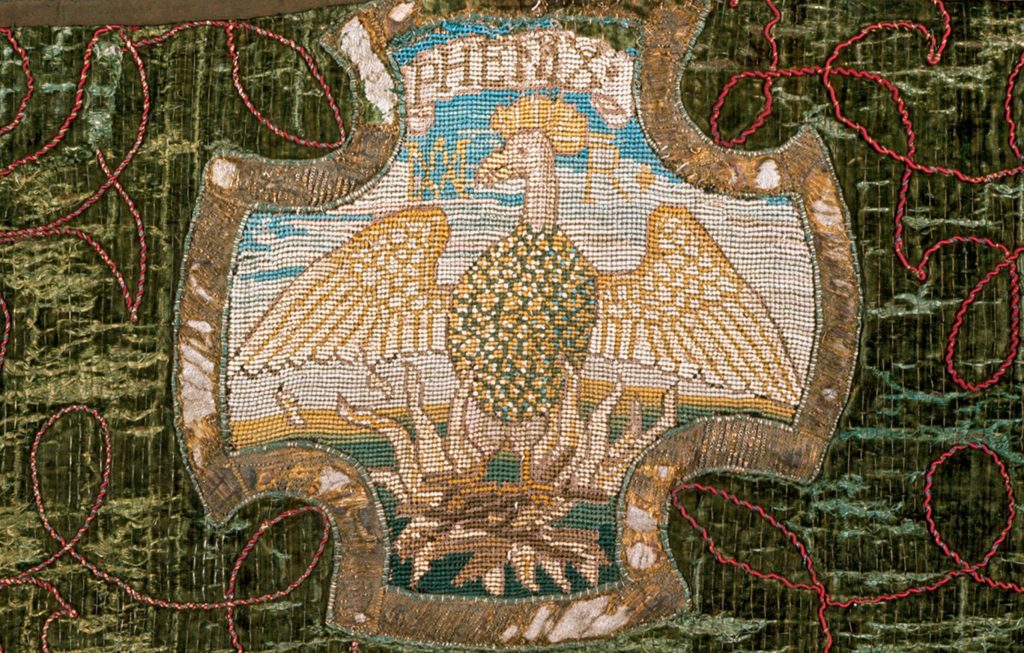
    Detail from the Marian Hanging, embroidery done by Mary, Queen of Scots and Elizabeth Talbot, Countess of Shrewsbury (late 16th century). More information at https://www.vam.ac.uk/articles/prison-embroideries-mary-queen-of-scots?srsltid=AfmBOor3Q6AX6jfFb3ad6OSOV9ptIaZuHVCh6u_eYfSQ6OCc2oix1UBo

    Not Just for Grannies (although grannies are amazing!)

    Embroidery today is far from the dainty samplers of the past. It’s a craft that’s been reclaimed by artists, activists, and creatives who use needle and thread to make bold statements, challenge stereotypes, and add a unique touch to everything from denim jackets to sneakers.

    Modern embroidery artists are stitching everything from feminist slogans and mental health affirmations to vibrant, abstract designs. It’s being used in high fashion, streetwear, and even digital art, with embroidered pieces turned into NFTs (yes, really!). And let’s not forget the power of hand-stitched protest banners—embroidered words can be just as powerful as those shouted in the streets.

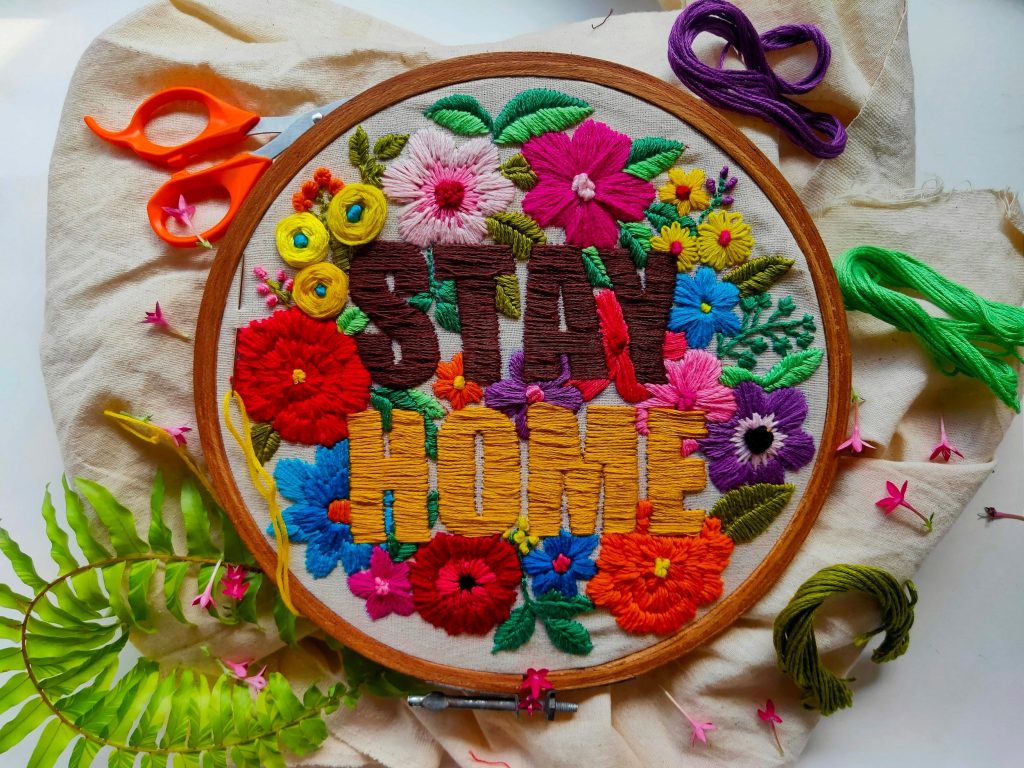
    A piece of embroidery which must have been stitched during the early days of the pandemic. I love how this piece of art is used to express how the artist was feeling at the time. Image: stock image from Squarespace

    The Ultimate Tool for Self-Expression

    One of the best things about embroidery is that you don’t need expensive equipment or years of training to get started. A needle, some thread, and a piece of fabric are all you need to begin creating something that is entirely your own.

    Unlike fast fashion, where everything is mass-produced, embroidery allows you to make something one-of-a-kind. Want to upcycle an old pair of jeans? Add some embroidered flowers or an inspirational quote. Need a mindful, screen-free hobby? Stitching is a slow, meditative process that helps reduce stress and improve focus.

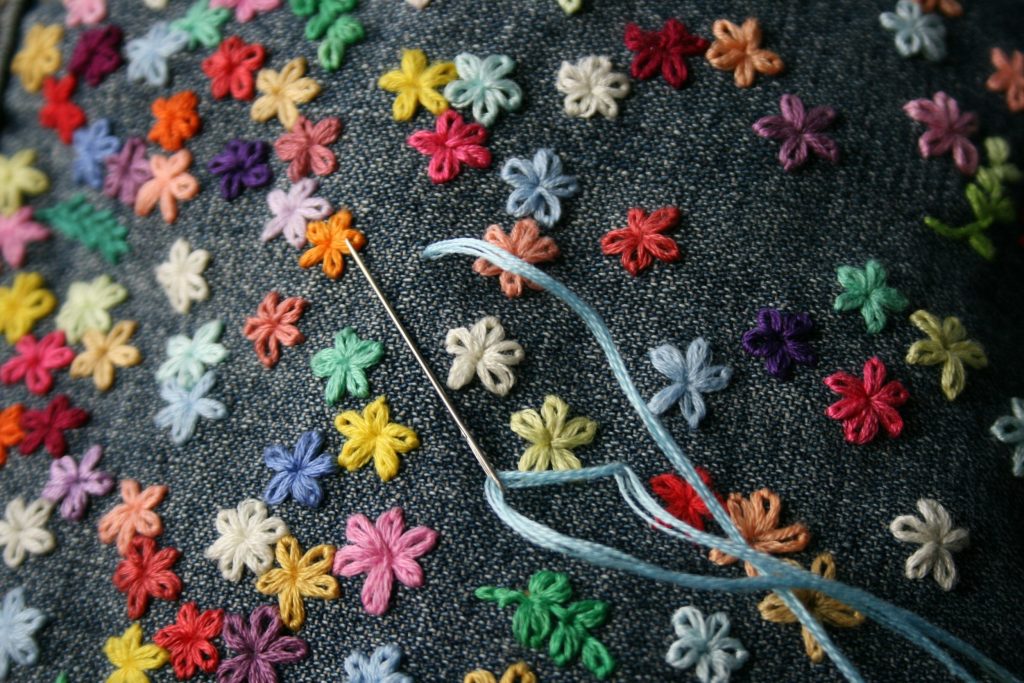
    Upcycling old jeans with lots of little lazy daisy flowers. This technique can be easily achieved by beginner stitchersImage: Squarespace Stock Images

    Scottish Textile Artists Keeping Embroidery Alive

    Scotland has a thriving community of embroidery artists who are pushing the boundaries of this heritage craft. Here are some names to watch:

    • Nikkita Morgan – An Irish textile artist based in Edinburgh, Nikkita uses embroidery to explore socio-political, cultural, and environmental issues. She has led community projects like Inverkeithing Stitching In Time, using textile art to interpret local history. Làmhan is proud to work with Nikkita, and she is our freelance lead textiles tutor. (nikkitamorgan.com)

    • Jilli Blackwood – A renowned Glasgow-based textile artist known for her unique “Slash and Show” technique, which combines hand-dyed fabrics with intricate embroidery to create stunning, textured works. (jilliblackwood.com)

    • Kim McCormack – Based near Beauly in the Scottish Highlands, Kim’s embroidery is inspired by nature, using textile techniques to capture the rugged beauty of the landscape. (kimberleymactextiles.co.uk)

    • Ruth Black – A textile artist in the Highlands who specializes in embroidery, feltmaking, and weaving, often incorporating elements of Scottish heritage and folklore into her work. (facebook.com)

    • Nicola McEachran (NDM Handmade) – A jeweller and embroidery artist who blends traditional stitching techniques with modern, minimalist designs. (blog.folksy.com)

    • EDGE Textile Artists Scotland – A collective of textile artists promoting contemporary embroidery and textile art across Scotland. (edge-textileartists-scotland.com)

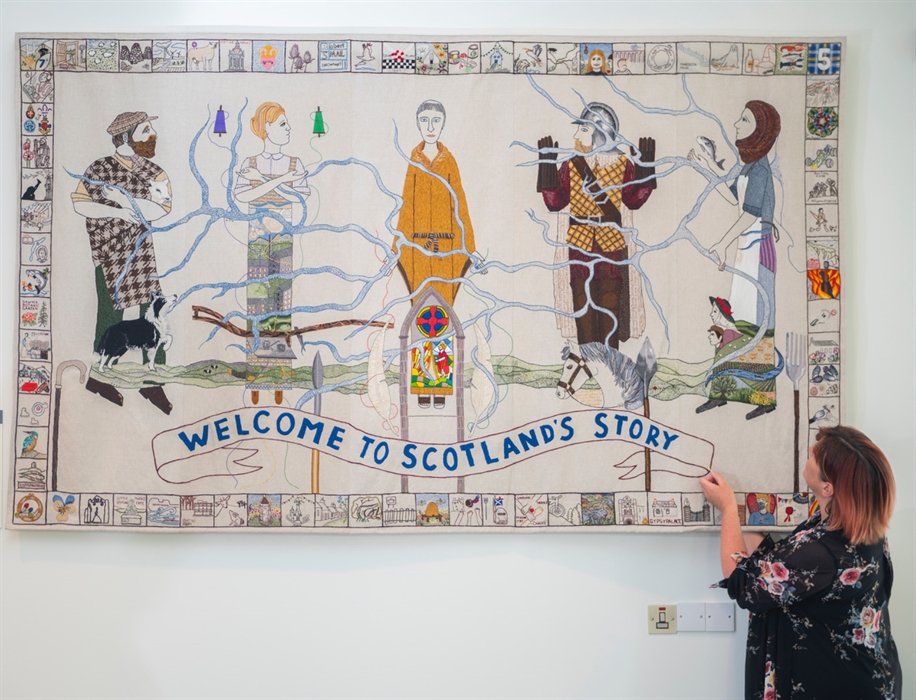
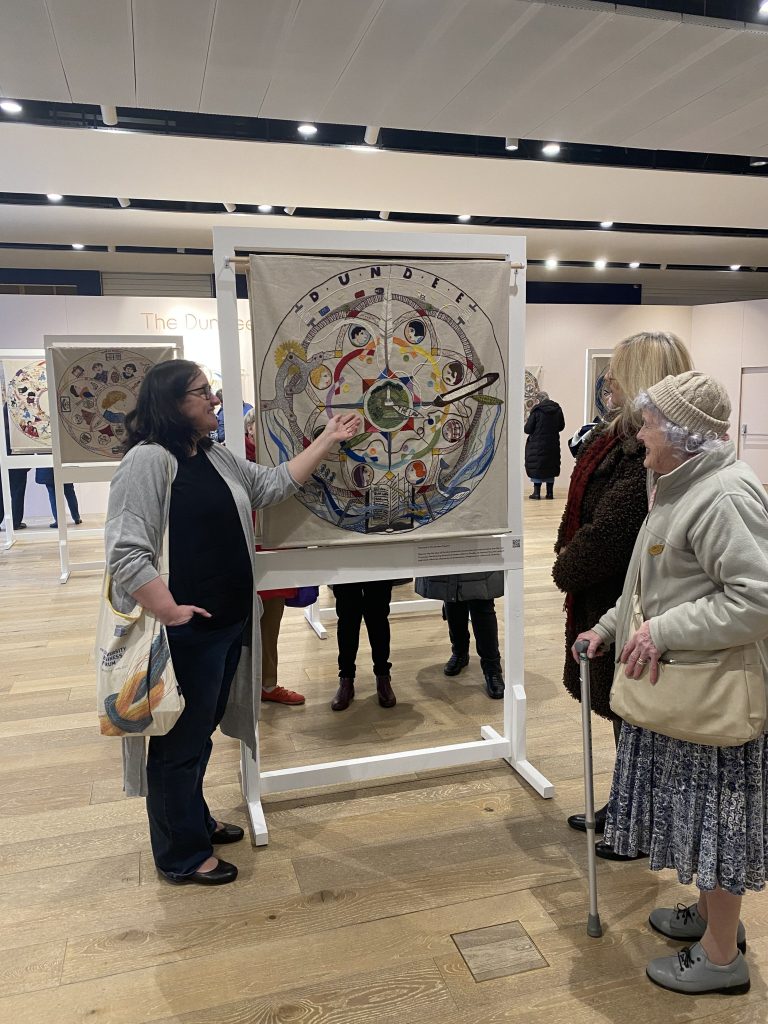
    Andrew Crummy, a Scottish artist renowned for his narrative embroidery, has significantly contributed to community art through the design of over 20 embroidered tapestries since 2009. His work often involves collaborative storytelling, engaging communities to depict their shared histories and cultural narratives. Notable projects include the Great Tapestry of Scotland, which illustrates the nation’s history through 160 panels, and the Battle of Prestonpans Tapestry, portraying the events of the 1745 battle. Other significant works are the Scottish Diaspora Tapestry, celebrating the global influence of Scots, and the Dundee Tapestry, which narrates the city’s rich heritage through 35 circular designs. These projects collectively form the Scottish Tapestry Trail, a testament to Andrew’s dedication to preserving and promoting Scotland’s cultural legacy through communal artistry. I am proud to know Andrew, and am proud to have been involved in one of his projects (the Dundee Tapestry).

    Why Embroidery Deserves Its Place in Scotland’s Heritage

    Despite its deep roots in Scottish history, embroidery—like many textile arts—is at risk of being forgotten. But by teaching these skills to new generations, we can keep this heritage craft alive and thriving. Whether it’s through traditional techniques or modern, bold designs, embroidery remains one of the most personal and powerful ways to tell a story through stitches. So, if you’ve ever thought embroidery was outdated, it’s time to pick up a needle and see for yourself. Stitch your thoughts, your dreams, your frustrations—whatever moves you. Embroidery isn’t just for grandmothers (though we should absolutely respect the embroidery queens who came before us). It’s for anyone who wants to make their mark—one stitch at a time.

    I am proud to know Andrew, and am proud to have been involved in one of his projects (the Dundee Tapestry).

    Why Embroidery Deserves Its Place in Scotland’s Heritage

    Despite its deep roots in Scottish history, embroidery—like many textile arts—is at risk of being forgotten. But by teaching these skills to new generations, we can keep this heritage craft alive and thriving. Whether it’s through traditional techniques or modern, bold designs, embroidery remains one of the most personal and powerful ways to tell a story through stitches. So, if you’ve ever thought embroidery was outdated, it’s time to pick up a needle and see for yourself. Stitch your thoughts, your dreams, your frustrations—whatever moves you. Embroidery isn’t just for grandmothers (though we should absolutely respect the embroidery queens who came before us). It’s for anyone who wants to make their mark—one stitch at a time.

  • Legacies of Slavery: Reflecting on a Complex Heritage in Rural Scotland

    Legacies of Slavery: Reflecting on a Complex Heritage in Rural Scotland

    The small village of Aberlour, which is beautifully situated near the river Spey in Moray and is famed for a whisky of the same name, and the even smaller neigbouring village of Craigellachie, stand as testaments to resilience, faith, and community spirit. Yet, like many places across Scotland, their history is entangled with the darker legacies of the transatlantic slave economy. A new project, Legacies of Slavery: Churches, Communities and Buiding a Fairer Future, led by Dr Jim MacPherson of the University of the Highlands and Islands (UHI) in partnership with the Church of Scotland, invites the local community to engage thoughtfully with this complex past.

    Using the case study of Alexander Grant of Aberlour and his niece, Margaret MacPherson Grant, the project encourages reflection on how the money made from chattel slavery in Jamaica were channelled back into the local community—particularly through the endowments that funded the building of Aberlour’s local Episcopal church. Through research, education, and creative expression, this initiative aims to foster an honest dialogue about the ways historical injustices continue to shape the present.

    A Legacy Rooted in Jamaica

    Alexander Grant’s life epitomises the intersections between Scotland’s local histories and the global reach of the British Empire. As an enslaver operating in Jamaica during the height of the transatlantic slave trade, Grant amassed considerable wealth from the forced labour of enslaved Africans producing sugar and rum. This wealth did not remain distant. Upon returning to Scotland, the money was infused into his local community through investments, philanthropy, and, notably, then through his niece, Margaret MacPherson Grant.

    Margaret, who inherited a significant portion of Alexander Grant’s fortune, became a well-known benefactor in Aberlour. Among her most enduring contributions was her financial support for the construction of the local Episcopal parish church—a structure still central to village life today. Yet beneath its stone walls and stained glass lies a more troubling story: one that ties the fabric of a Scottish community to the brutal realities of Caribbean plantations.

    Uncovering and Confronting Hidden Histories

    The Legacies of Slavery project seeks not to erase or diminish the importance of the church and its place in the community, but rather to provide a fuller, more honest understanding of how it came to be. By focusing on Alexander and Margaret’s intertwined stories, the project opens a necessary space for local people to consider how slavery’s profits helped shape their familiar surroundings.

    This approach reflects a broader movement across Scotland and the wider UK to reckon with the deep imprints of slavery on national and local histories. Through research and public engagement, communities like Aberlour and Craigellachie are beginning to ask difficult but essential questions: Whose suffering financed our heritage? How should we commemorate benefactors whose wealth was built on human misery? How do we balance pride in local traditions with an awareness of their origins?

    The Colonial Countryside project, led by Professor Corinne Fowler of the University of Leicester in collaboration with the National Trust, exemplified how difficult histories—particularly those involving chattel slavery and colonialism—can be meaningfully explored through creative expression. This pioneering initiative engaged around 100 children from diverse backgrounds in researching and reinterpreting the colonial histories of (English) National Trust properties. Through writing workshops, public speaking events, and the co-creation of exhibitions, these young participants brought to light the often-overlooked connections between Britain’s country houses and its imperial past. Their creative outputs not only enriched public understanding but also demonstrated that confronting uncomfortable aspects of history can foster education, empathy, and dialogue within communities. 

    This video below is my favourite outcome of this project, which I am sure you will agree is beautiful.

     Creativity & Healing Through Textiles

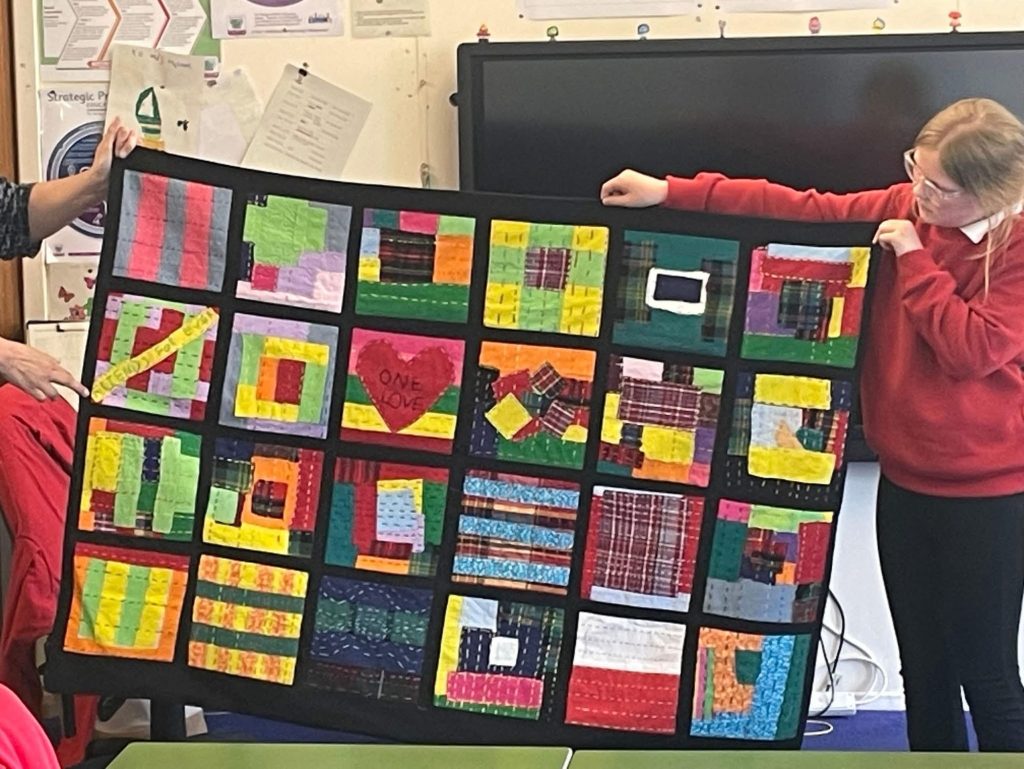
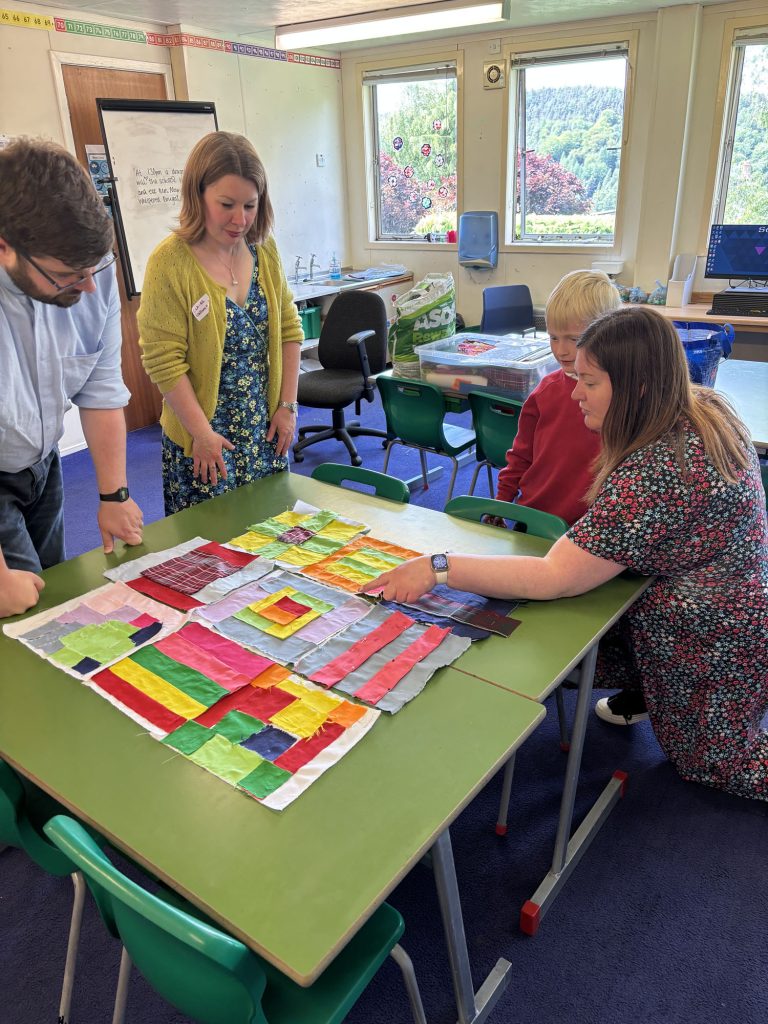
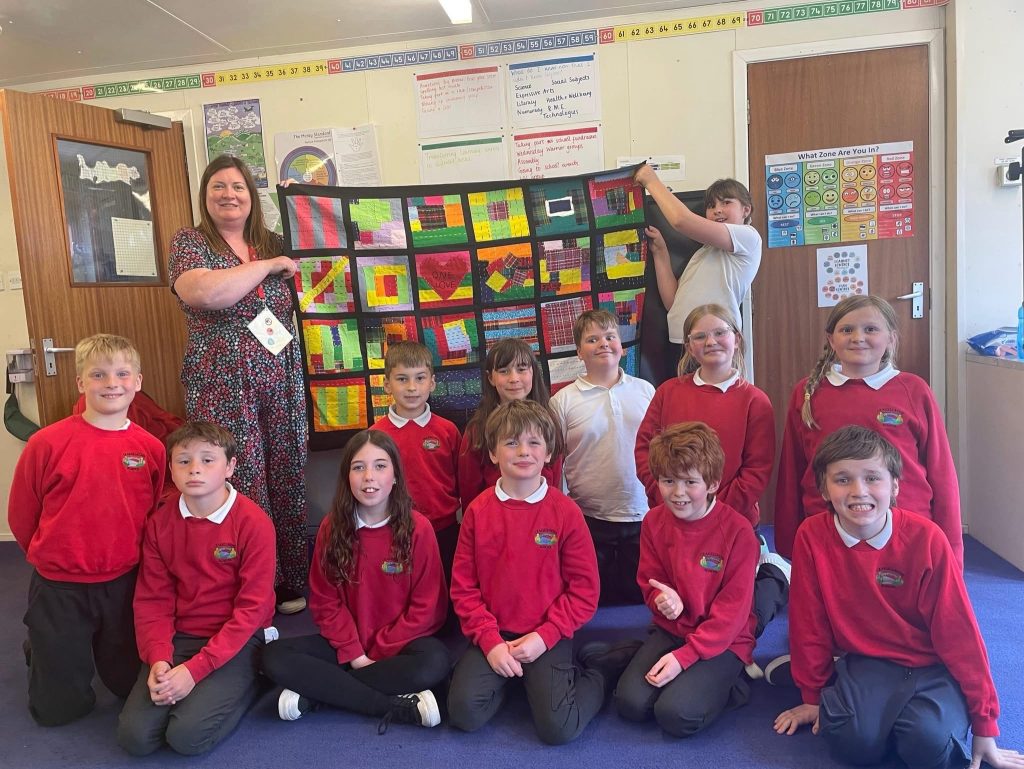
    One of the project’s most innovative components involves the use of creative textile art to engage with these heavy themes. Jo Watson of Làmhan, a former UHI postgraduate student who studied the legacies of slavery under Dr MacPherson, will be leading a series of textile workshops for children and parishioners. These sessions aim to explore sensitive histories through tactile, participatory means. Jo will be leading sessions with local communities and schools in May and June 2025.

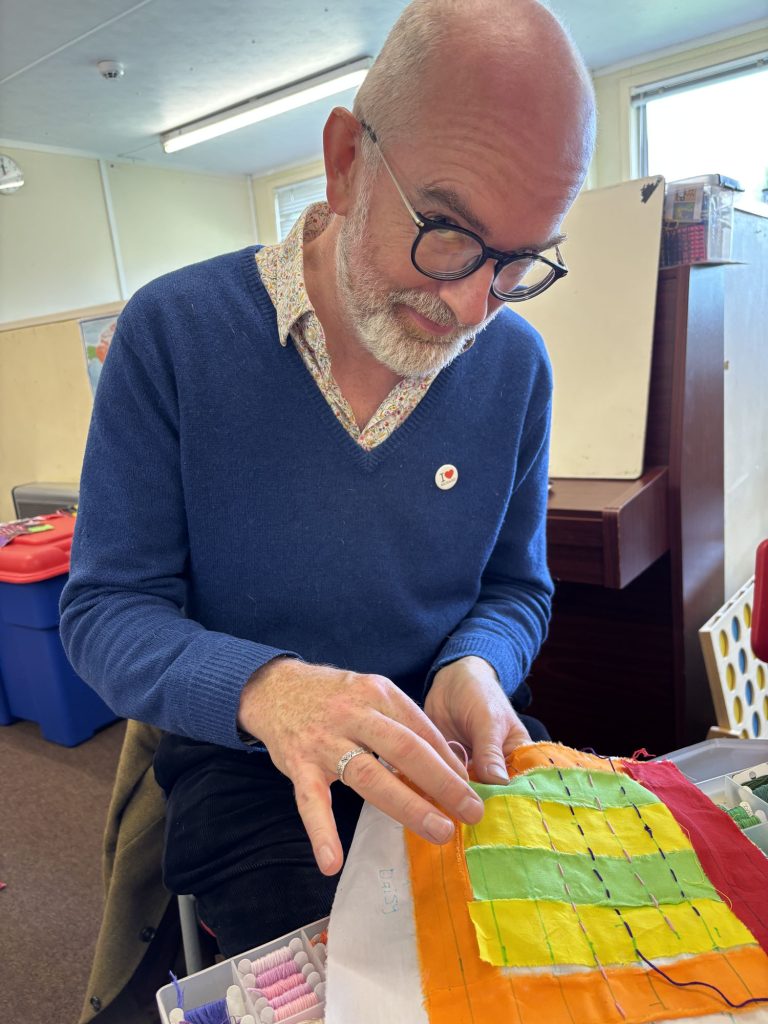
    Textile work has long been a medium for storytelling and memory-keeping. By designing then stitching, and creating together, participants are offered a gentle but profound way to process difficult knowledge and to contribute to a new, collective memory for Aberlour and Craigellachie —one that acknowledges pain but also looks toward hope and understanding.

    Jamaican bandana cloth, characterised by its vibrant check patterns, has a complex history that intertwines colonial legacies with cultural reclamation. Originally produced in Madras (now Chennai), India, this lightweight cotton fabric was exported by the British during the late 18th – 19th century to clothe enslaved individuals in the Caribbean due to its affordability and durability. 

    Over time, Jamaicans have transformed bandana cloth into a symbol of national pride and cultural identity. Notably, folklorist Louise Bennett-Coverley, affectionately known as ‘Miss Lou,’ popularised the fabric by incorporating it into traditional performances, solidifying its place in Jamaican heritage. The bandana’s check design bears a resemblance to Scottish tartan, reflecting the historical connections between Scotland and Jamaica, including the migration of Scottish settlers and the influence of Scottish culture on the island, as well as on Chennai. Today, bandana is prominently featured in Jamaica’s national costume and is worn during cultural celebrations, symbolising resilience, and the enduring spirit of the Jamaican people. To learn more about this cloth, and other textiles worn by the enslaved, please see this excellent blogpost.

    In our upcoming textile workshops, participants will have the opportunity to work with authentic Jamaican bandana cloth alongside locally sourced Scottish textiles. This hands-on experience aims to foster a deeper understanding of the intertwined histories and cultural narratives embodied in these fabrics, encouraging creative expression and reflection within the community.

    The workshops will encourage participants to interpret what they have learned about Aberlour and Craigellachie’s connections to slavery and express their reflections through textile art, culminating in a banner for display in the church. In doing so, the community becomes active agents in shaping the narrative, bridging the gap between past injustices and present consciousness.

    The image below comes from James Hakewill’s A Picturesque Tour of the Island of Jamaica, 1820-1821. Which you can view online here

    Reflection, Responsibility, and Renewal

    Projects like Legacies of Slavery do not offer easy answers. Instead, they provide frameworks for grappling with the moral complexities of history. They call on communities to recognise that the benefits of past injustices often still ripple through societies today—economically, socially, and culturally.

    For Aberlour and Craigellachie, this means reflecting not only on the building of a church but on the lives irreparably harmed to make such philanthropy possible. It means accepting that history is rarely pure or simple. And it means committing to education, dialogue, and remembrance in ways that honour all parts of the story.

    At the same time, the project highlights the possibility of renewal. By engaging children, parishioners, and the wider community in reflective and creative acts, Aberlour and Craigellachie are demonstrating that facing the past honestly can lead to stronger, more compassionate communities.

    Looking Forward

    The Legacies of Slavery project is part of a broader societal shift towards reckoning with uncomfortable histories. Yet it is also uniquely rooted in its local context, responding to the specific heritage, architecture, and people of Aberlour and Craigellachie.

    In recognising the full story of figures like Alexander Grant and Margaret MacPherson Grant, the community is not tearing down its past but enriching it—making room for deeper understanding and a more inclusive memory. By integrating research, creative expression, and open conversation, Aberlour and Craigellachie are taking meaningful steps towards acknowledging their place in a global story of suffering, survival, and the ongoing quest for justice.

    Through projects like this, small communities across Scotland are demonstrating that the legacies of slavery are not merely historical footnotes but living realities that deserve careful attention. In Aberlour and Craigellachie, threads of history, memory, and hope will be stitched together—one thoughtful conversation, and one piece of fabric at a time.

  • Threads of history: Rediscovering Bonnie Prince Charlie

    Threads of history: Rediscovering Bonnie Prince Charlie

    When we think of historical figures, we often imagine portraits, letters, or battlefields—but sometimes, the most personal insights come from the clothes they wore. In the Threads of History: Rediscovering Bonnie Prince Charlie project, we’re taking a fresh approach to historical research by quite literally measuring the past—using bespoke garments to uncover the physical dimensions of those who wore them.

    This innovative study, created by Jo Watson, founder and CEO of Làmhan, combines the artistry of historical tailoring with the intrigue of Scottish history. And at its heart is a single, extraordinary waistcoat.

    A Waistcoat with Provenance

    On the morning of 24th August 1745, Prince Charles Edward Stuart—better known as Bonnie Prince Charlie—left behind a waistcoat at Fassifern, near Achnacarry, in the Scottish Highlands. This garment, now preserved in the Clan Cameron Museum, is of exceptional historical value. Unlike many items attributed to historical figures, the provenance of this waistcoat is absolute. We know it was worn by the Prince. That fact makes it an invaluable reference point in our quest to understand his wardrobe and physical stature through the cut and construction of his clothes.

    Measuring the Man through the Garment

    This waistcoat isn’t just a relic—it’s a blueprint. Bespoke garments, especially those from the 18th century, were crafted to fit the individual wearer with remarkable precision. Every dart, seam, and curve was tailored to suit the wearer’s unique build. By carefully analyzing the structure and dimensions of this waistcoat—armhole depth, chest width, waist size, length from shoulder to hem—we can reconstruct an accurate profile of Prince Charles Edward Stuart’s physique, including a strong estimate of his height and posture.

    A key measurement, for instance, is the distance from the nape of the neck to the natural waist, which typically equals about one-quarter of an adult’s height. This proportion allows us to make informed estimates of overall height from partial garment measurements. By applying this principle to the Prince’s waistcoat, we can determine his likely stature and use this data to assess whether other garments—such as tartan trews and other waistcoats—could plausibly have belonged to him.

    This method has been inspired by the groundbreaking work of Mark Hutter (historical tailor) and Brooke Wellborn (historical dressmaker), whose 2024 project with Mount Vernon in the United States explored the clothing of Martha Washington. Their meticulous research demonstrated how physical garments could be used to reconstruct bodily dimensions and confirm provenance. Their pioneering approach has directly influenced the direction of our own research in Scotland.

    Free public events

    We were excited to invite the public to experience the Threads of History project in person between Wednesday 16th April – Saturday 19th April 2025. Visitors to the Clan Cameron Museum and the West Highland Museum had the opportunity to meet historical tailoring expert Michelle Barker, master weaver Claire Hunter, our founder Jo, our trustee Carolyn to discuss the project and what we were doing. We spoke with almost 100 people about the project (and Jo got to practice her French and German to a number of the visitors too, and learned the French term for trews – un pantalon troué- which she didn’t know before!). All four days were free of charge and included with donations or admission to the museums. We spoke with people from all over the world, including the west coast of Canada, USA, France, Germany and Spain as well as Scotland and England. We enjoyed ourselves so much that we are hoping to repeat the experience in June at the West Highland Museum, where we will be studying Bonnie Prince Charlie’s waistcoat.

    Meet our Experts

    Michelle Barker is the founder of both the Georgian Costume Study Centre (link) and HandBound Costumes, (link) and has been immersed in the study of 18th-century clothing since 2012. With a deep passion for original techniques and an analytical approach to historical tailoring, Michelle has committed herself to understanding the practices of mantuamakers and tailors of the Georgian era. Her work involves documenting patterns, reconstructing period garments, and training others in historical methods. She has studied and recreated over 30 pairs of stays, analysing the materials, shapes, and stitching techniques used to create the iconic silhouettes of the period. Michelle’s hands-on reconstructions form a vital part of her research process and allow modern audiences to engage meaningfully with 18th-century fashion.

    Claire Hunter is a master weaver and the founder of Taffled Threads (link) , established in 2016. After graduating from the Scottish College of Textiles in 1997, Claire worked with a Scottish mill creating high-end furnishing fabrics and tartan designs for clients across the UK, Europe, and America. With a strong foundation in traditional weaving techniques and textile design, Claire eventually returned to her roots and established her own studio to pursue independent creative work. Taffled Threads reflects her commitment to Scottish textile heritage, and she now specialises in weaving historically informed textiles and tartans. Claire’s expert knowledge is vital to understanding the cloth used in garments attributed to the Prince and offers insight into the materials available to Highland communities in the 18th century.

    Our New Approach to Old Clothes

    Using garments of known provenance to confirm the authenticity of others is a rigorous and rarely used method in Scottish historical research. In fact, I’m not aware of it having been done before. Our approach combines the precision of tailoring, the science of body proportions, the logic of detective work, and the storytelling power of material culture. This is not just about fabric or something in a museum; it is about connecting the past and present through craftsmanship, scientific methods and thereby grounding myth in material evidence.

    We aim to present our findings from this project at NTS Glenfinnan on 20th August 2025; 280 years to the day after the prince was there.

  • Stitching for the Soul: The Mental Health Benefits of Sewing in Small Groups

    Stitching for the Soul: The Mental Health Benefits of Sewing in Small Groups

    At Làmhan, we’ve always known about the quiet power of creativity—and nowhere is that more evident than in the simple, mindful act of sewing. Over the past few months, we’ve seen firsthand just how profoundly sewing can impact mental well-being, especially when done in the company of others.

    Our recent eight-week parents and children workshops brought together families in Stirling for shared moments of creativity, conversation, and calm. Every participant in the programme reported an improvement in their mental health, with many describing the sessions as a rare chance to truly switch off from the pressures of everyday life—and particularly from screens and constant digital distractions.

    One parent told us, “It was the only time in the week when I really felt present. No emails, no phones—just me and my daughter, learning and making something together.” Comments like this reflect what studies have shown for years: that hands-on activities like sewing can reduce anxiety, improve focus, and foster a sense of accomplishment and control.

    But the benefits didn’t stop with the sewing itself. The group dynamic added another powerful layer. Sewing in small groups encourages natural conversation and peer support, creating a space that is both therapeutic and social. It’s in these shared silences, quiet laughs, and gentle guidance from one pair of hands to another that bonds form and confidence grows.

    As we look ahead, we’re more committed than ever to expanding this work. Làmhan is currently working hard to establish a new permanent base for the charity right here in Stirling. This is why we are taking a break from teaching just now. Once our new studio is ready to open, we’ll be able to significantly increase the number of workshops, support more young people and families, and offer more regular programming for everyone.

    Our goal is simple: to create a space where anyone—regardless of background or experience—can feel welcome, be creative, and leave feeling a little lighter than when they arrived.