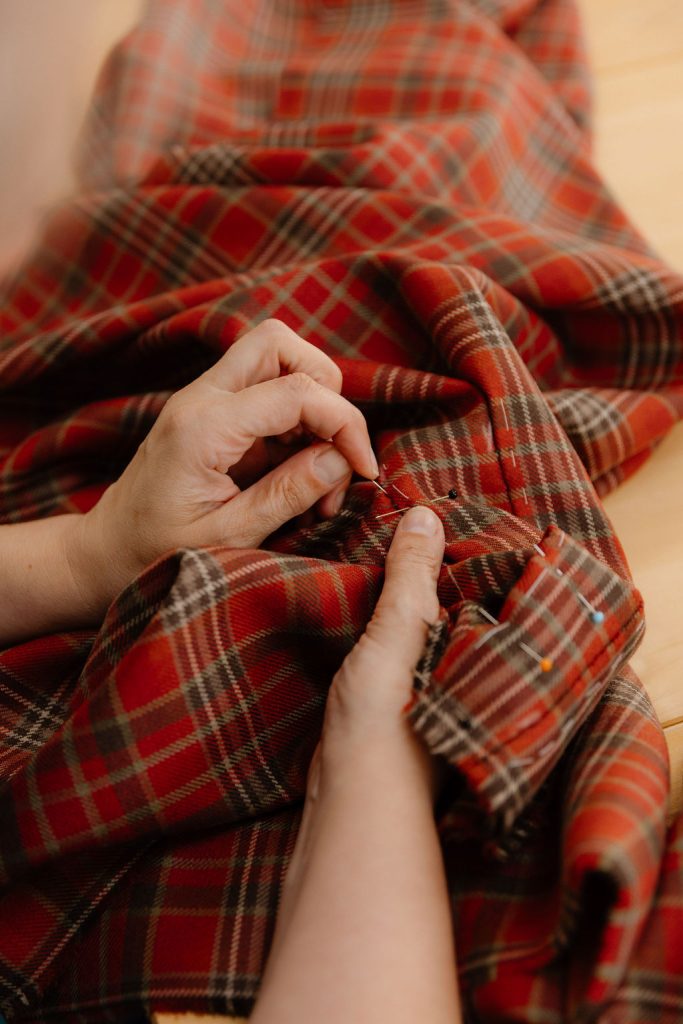
I have been thinking a lot since the Heritage Crafts event last week — about the conversations I had, the shared concerns that kept coming up, and the quiet agreement in the room that something needs to change if traditional crafts like kiltmaking are going to remain viable in the long term. One conversation in particular stayed with me: I spoke with an academic who is researching pay and working conditions in kiltmaking, and hearing their perspective really sharpened some of the questions I have been grappling with at Làmhan.
One theme that came up again and again was sustainability. Not environmenal sustainabilty – another topic all together which we are passionate about. About financial sustainability for organisations, but alo sustainability for the people actually doing the making — particularly in the context of the rising cost of living. Fair pay, realistic expectations, and working structures that do not rely on burnout or unpaid labour felt more urgent than ever. That is something we have been reflecting on deeply at Làmhan over the past year, and it has shaped the way we are approaching our next phase of work.
We are about to launch a new project focused on supporting traditional kiltmaking through transparent pricing, fair pay, and flexible, home-based working. The project is still in its initial stages, but the values underpinning it are clear: recognising experience, paying makers properly for their skill and time, and building a model that can support both established makers and those earlier in their careers. We will be launching our new service in the Spring.
Before going any further, it is important to say this clearly: this pricing structure is not intended to be an industry standard. Kiltmakers and other professionals are of course free to charge whatever they feel is appropriate for their work, and there is no single “right” way to price a handmade garment. What follows simply reflects how we have chosen to work at Làmhan, based on our values, responsibilities as a charity, and the realities of our context.
To support this work, we are now inviting applications from kiltmakers to work with us on a freelance basis. We are interested in hearing from makers at a range of experience levels, from apprentices through to highly experienced kiltmakers. All work will be commissioned individually, with kilts made from the maker’s own home workspace.
A core part of this project is transparency about both maker pay and customer pricing. Each kilt will be priced as labour + cloth + materials. Labour prices will be set according to the experience of the kiltmaker. From the labour price paid by the customer, a fixed £100 contribution supports Làmhan’s charitable work, including coordination, administration, training, and long-term sustainability. All remaining labour will be paid directly to the kiltmaker on a per-kilt basis.
Cloth will be charged separately at cost, as tartans are priced differently by mills. Most traditional 8-yard men’s kilts require four metres of double-width tartan, typically priced at £30–£35 per metre. Very tall clients may require eight metres, as cloth cannot be split. In addition, a fixed £20 materials charge applies to every kilt, covering buckles, canvas, thread, and internal construction materials.
Kiltmaker pay and indicative customer pricing (men’s hand-sewn kilt)
| Experience level | Years of experience | Paid to kiltmaker | Charity contribution | Labour charged to customer | Estimated total price* |
| Apprentice | 0–1 year | £400 | £100 | £500 | ~£650 |
| Junior | 1–3 years | £500 | £100 | £600 | ~£750 |
| Established | 3–5 years | £600 | £100 | £700 | ~£850 |
| Senior | 5–10 years | £700 | £100 | £800 | ~£950 |
| Master | 10+ years | £800 | £100 | £900 | ~£1,050 |
*Estimated total includes labour, £130 cloth (average) and £20 materials. Cloth costs vary by tartan and height.
These rates assume a traditional hand-sewn men’s kilt and reflect both experience and efficiency. Work will be paid per kilt rather than per hour, allowing experienced makers to benefit from speed and judgement while ensuring apprentices are paid fairly.
We recognise that commissioning a handmade kilt is a significant purchase. Customers will be able to pay in instalments, allowing the cost to be spread over time. This does not change the total price and helps make a commissioned garment more manageable, while ensuring kiltmakers are paid fairly and promptly.
Short interviews with kiltmakers will be held via Microsoft Teams, and we aim to keep the process straightforward and respectful of people’s time.
To apply, we ask for a short covering letter telling us about your kiltmaking practice, why you are a kiltmaker and why you want to work with us, a CV or work history, and a portfolio of work. Portfolios can be shared in whatever format suits you best — photographs, a website, Instagram, or a PDF are all welcome. Please email to Jo at hello@lamhan.scot. Ideally we’d like to see several different styles.
The deadline for applications is 16th February at 5pm.
If you have any questions before applying, you’re very welcome to send us a message on Instagram or email Jo at hello@lamhan.scot.
This project is still evolving, but it’s rooted in conversations like those at the Heritage Crafts event — conversations about how we value skill, how we support people to stay in the craft long term, and how we build systems that are fair, transparent, and sustainable. We’re looking forward to seeing where it leads, and to working with kiltmakers who share those values.